 North West Social Science Doctoral Training Partnership
ShowCASE Seminar Series
Natalie Taylor, Psychology, University of Liverpool (2021 Cohort)
NWSSDTP CASE Studentships are unique in that they provide opportunities for PhD students to work collaboratively on a doctoral project with non-HEI institutions or organisations, being supported by both expert academic supervisors and an external co-supervisor.
As CASE students, we wanted to create a platform for CASE students and their organisational partners to present their work and research, discuss and promote collaborative research opportunities, and reach new audiences in terms of support, promotion and education. We also were keen to build a community of CASE students and partners, enabling sharing of experiences and networking to initiate future ideas and collaborations. Hence, the ShowCASE series was born!
Read MoreTransforming by Encountering ‘the Other’

Daniela Fazio Vargas, Sociology, University of Manchester (2021 Cohort)
From the 17th to the 21st of April, the British Council organised a series of cultural events as part of their “Peace and Beyond” to commemorate the 25th anniversary of the Good Friday Agreement. They invited delegates from over ten different countries to discuss the role of arts in polarised societies and examine how artists and creative grassroots communities have contributed to the transitional process of Northern Ireland. I was invited to participate in the panel Diverse Voices Shaping Positive Peace through Socially Engaged Arts where, together with Carlos Pineda Ramos (PhD student at the University of Bristol), we had the opportunity to present and talk about our essay with the Artistic Director of the Kabosh theatre, Paula McFetridge, a Colombian musician and social leader, César López, and some British Council members interested in arts and culture.
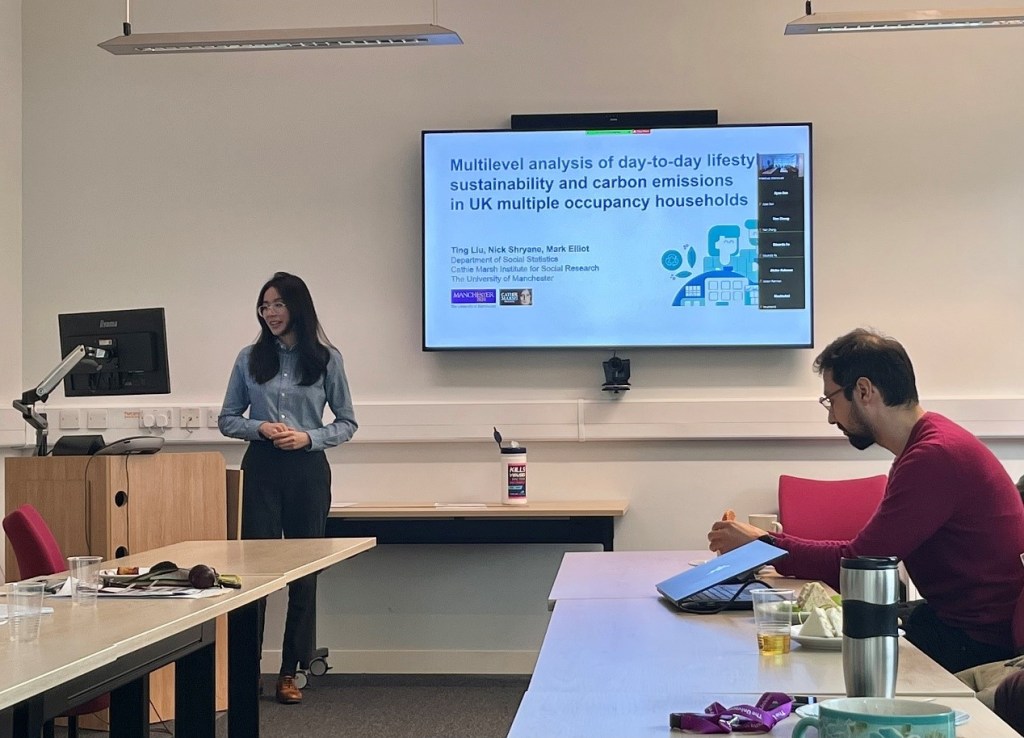
Read MoreSustainable Lifestyle and Carbon Emissions: Presenting at the Departmental Seminar
Ting Liu, Social Statistics, University of Manchester (2019 Cohort)
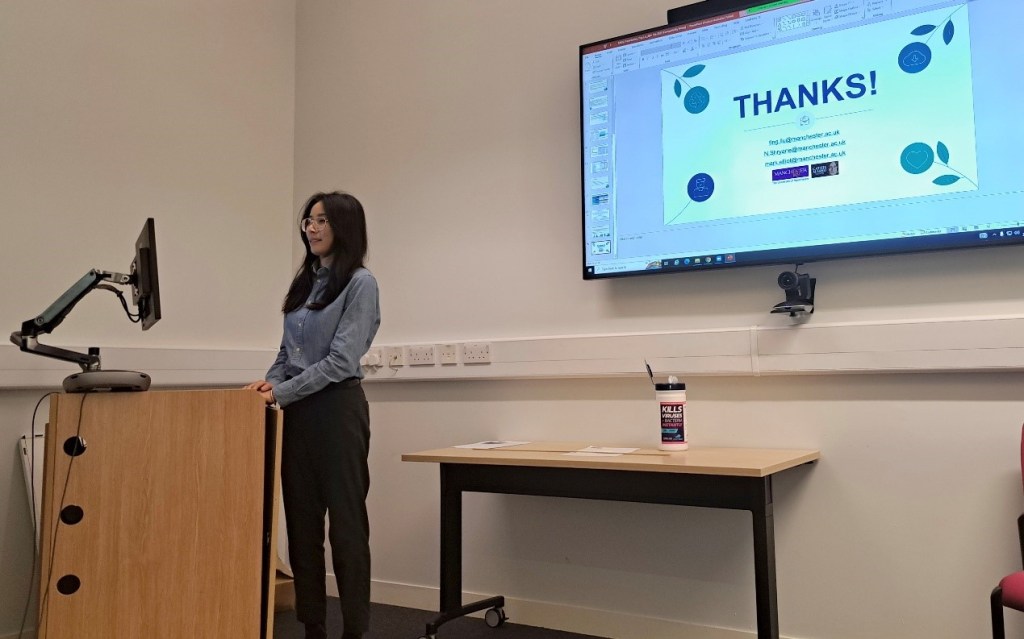
As a PhD student, presenting my research at the Departmental seminar is an important milestone in my academic journey. It is an opportunity to showcase my work to colleagues in the Department of Social Statistics and receive valuable feedback on my research findings.
My research focuses on the relationship between sustainable lifestyle and household carbon emissions in the UK population. This is an incredibly important topic, especially given the urgent need for the UK to reduce its carbon budget and to take action to mitigate climate change. I noticed that the audience was engaged and attentive, eager to learn more about the way small sustainable practices in daily life within households contribute to cutting down carbon footprints.
Presenting interdisciplinary research between environmental and social science in front of a live audience, working in the area of social statistics, can be a daunting experience. As I prepared for the presentation, I felt a mixture of excitement and nerves. When it was finally my turn to present, I felt a rush of adrenaline. However, I felt a sense of pride as I shared my findings, highlighting the ways in which sustainable lifestyle choices can help reduce household carbon emissions, such as switching off lights in rooms that aren’t being used and putting more clothes on when feeling cold rather than turning the heating on or turning it up.
Throughout my presentation, I fielded questions and comments from the audience, which helped me to further refine my research and gain new perspectives on the broader social and political implications of my work. One area of particular interest that was discussed during the seminar was the potential impact of remote work on household carbon emissions. As more and more people have shifted to working from home during the COVID-19 pandemic, there has been increasing interest in understanding how this trend could impact energy usage and carbon emissions. This also implies the possibility of conducting a comparative analysis of the sample before and after the pandemic, which would allow us to better understand the influence of remote work on carbon emissions. This is an exciting area of research that has important implications for individuals, households, and organizations.
In addition to presenting my research, I also learned a great deal from the other presentations and discussions that focus on the effects of neighbourhood characteristics on bike-sharing systems. By having valuable connections with other researchers who are working in related areas, I gained new insights into the potential impact of sustainable transportation choices on motor emissions. By participating in conversations about the future of research in this area, I realized the practical implications that expanding shared bikes to achieve accessible cities and equitable transport benefits can have on low-carbon development with slashing emissions caused by private cars and road fuel. I had the opportunity to learn from my peers and trigger new inspirations into the ways in which it can be applied to real-world carbon reduction problems. This is one of the many benefits of attending academic seminars. I was grateful to gain a sense of camaraderie with my colleagues, who were all working towards the shared goal of advancing scientific knowledge.
Overall, I left the seminar feeling more confident in my abilities as a researcher and more excited than ever about the implications of my work. As I continue my academic journey, I can draw on this experience as a source of inspiration and motivation, knowing that my research has the potential to make a real difference in the world.
Generation Delta

Meghan Grant, Geography & Environment, University of Liverpool (2021 Cohort)
Generation Delta is a project which aims to support the next generation of women professors of colour. The project is coordinated across six universities and puts on workshops to support PhD students throughout the PhD process. As a host of Bending Boundaries, a Podcast sponsored by the NWSSDTP, this event also felt very relevant to the equality and diversity aims of the DTP. Bending Boundaries aims to encourage a broader range of applications to do a PhD but also highlight the fascinating research that can be done during a PhD. These sessions highlighted the ups and downs of doing a PhD but also practical steps to make the process more manageable.
Read More North West Social Science Doctoral Training Partnership