 North West Social Science Doctoral Training Partnership
Documenting the ‘joys, pains, and dreams’ of Maya community members in southern Belize

Cara Westerberg Mattu, Development and Humanitarianism in an Unequal World, University of Liverpool (2021 Cohort)
This summer was exciting, nerve-wracking, and eye-opening. During August and September, I spent time in Belize as part of my fieldwork. My research aims to explore the joys, pains, and dreams of Indigenous Maya youth, with a focus on socio-spatial environmental, cultural, and political factors affecting the Maya-defined wellbeing and autonomy through participatory research. The concept and driving force behind exploring and documenting the ‘joys, pains, and dreams’ of Maya community members in southern Belize is a particular area of research that has been developed by the Maya Leaders Alliance and the Julian Cho Society. I am fortunate that the MLA and JCS are the organisations in support of my PhD as part of my CASE studentship. The MLA and JCS are Indigenous grassroots organisations committed to advancing Indigenous land rights, education initiatives, and supporting the wellbeing of Maya communities. Whilst excited, I was incredibly nervous for different reasons; from my irrational fear of airport security, to leaving my loved ones in the UK.
Read MoreMy experience at the Collaborative Writing Hub
Daniela Fazio Vargas, Sociology, University of Manchester (2021 Cohort)
Writing can be frightening. We all know the cliché of the “blank page” and how much anxiety it creates to “make sense of things” with words – especially during the PhD when we are constantly expected to write, organise and analyse different sources of information. I have been feeling this anxiety even stronger ever since I started my third year. Being aware that the “end” is approaching and that I would need to put all my chapters together has haunted me these past few months. For that reason, when I saw the possibility of joining the collaborative writing hubs, I did not doubt for a second! That is why I decided to join the first writing retreat organised by the NWSSDTP in partnership with Liverpool John Moores University, which took place on the 20th of October.
Read More‘Collaborative Doctoral Writing Hubs’: Writing Retreats for Doctoral Students

Mya Kirkwood, Business and Management, University of Liverpool (2023 Cohort)
It’s rare to go to a writing retreat and actually enjoy yourself – but the collaborative writing retreat between the NWSSDTP and Liverpool John Moores University was a fantastic experience which did just that!
Read MoreFeminist Inquiry: BSA Regional Postgraduate Event, 10th October 2023
Adele Moore, SSSTM, University of Liverpool (2020 Cohort)
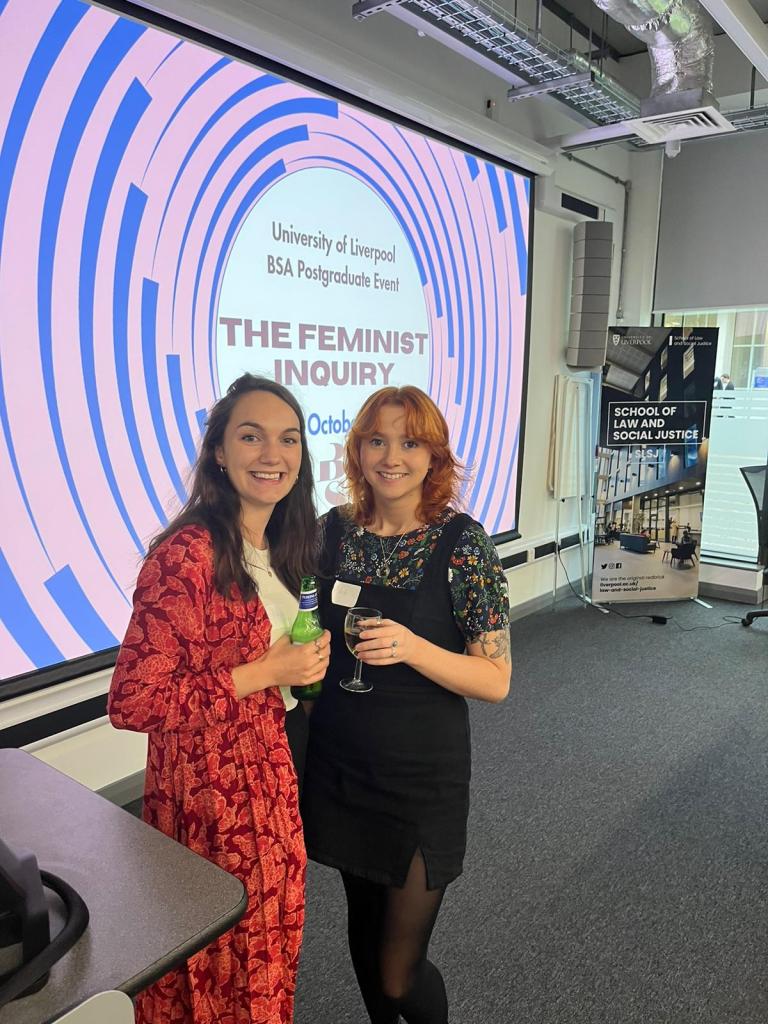
On Tuesday 10th of October, one of our student reps, Adele Moore, co-hosted an event called ‘Feminist Inquiry with her colleague, Lara MacLachlan. The event was funded through the British Sociological Association’s Regional Postgraduate Award, and the SLSJ Research Cluster, ‘Publics and Practices’.
This symposium sought to highlight the value and importance of feminist thinking to the field of sociology. Organised by and for PGRs, we managed to bring together UK-based PGRs involved in or who are interested in feminist perspectives.
Read More
