 North West Social Science Doctoral Training Partnership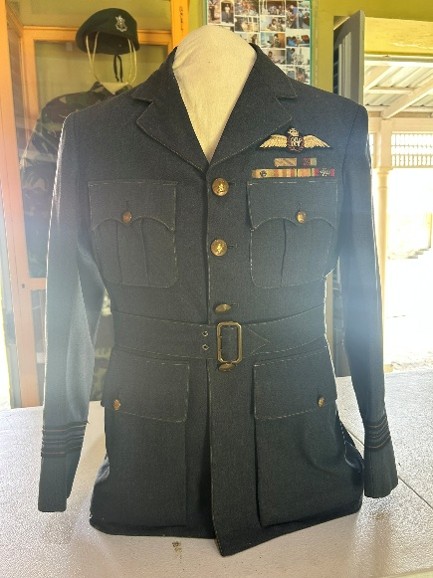
Aubrey ‘Sinbad’ Inniss, RAF Uniform, collection of the BMHS
Robin Plant, Economic & Social History, University of Liverpool (2024 Cohort)
Earlier this year, I had the opportunity to complete my Research in Practice Placement with the Barbados Museum & Historical Society. The first month of which was spent on the island, cataloguing and researching the museum’s military collections.
Before detailing the research and time spent in Barbados, I thought it would be useful to explain the practicalities of organising a student-led placement. The first thing to note is that there is a bi-monthly deadline for the proposal form (the 15th Jan, Mar, May, Jul, Sep, Nov) and applications need to be submitted a minimum of two months before the activity commences. The form requires an outline of your PhD research project (300 words), an explanation of the placement, including timelines and key objectives, and what you hope to gain from the experience for your personal and career development. Additionally, a breakdown of the expenses you wish to claim – up to £1000.00 is available. Additionally, your visiting institution needs to provide a record of placement details, focus, and schedule, which is submitted to the funding body.
The Barbados Museum & Historical Society was founded by an Act of Parliament in 1933 and is located in the UNESCO World Heritage Site of Historic Bridgetown and its Garrison, with the galleries being housed in military prisons originally constructed in 1818 and expanded in 1853. The focus of my placement was to catalogue and document the objects within the museum’s military collections. This included researching the provenance and details of specific objects. I reported my findings in a presentation to my supervisor and the museum director. Throughout the placement, I developed the skills required to handle and research museum artefacts. Additionally, it allowed me the opportunity to work in Barbados, complementing the focus of my PhD project, which examines the material world of plantation slavery in the British Caribbean.
The first week of the placement was spent researching and writing brief descriptions of objects on display in the Military Gallery. In a display case on the right side of the room as you enter is an RAF tunic that was donated to the Museum by the Inniss family in 1985, as detailed in the museum’s accession records. It belonged to Aubrey ‘Sinbad’ Richard de Lisle Inniss (1916 – 2003), who was a decorated pilot who flew in several campaigns during the Second World War. He was awarded the Battle of Britain Clasp, which is indicated by the gold and silver rosette on the 39-45 star ribbon on the top right of the uniform. He was the only Bajan to be awarded this honour. Additionally, he served in the Italian Campaign and flew operations from a Mediterranean base 1943-45. Thank you to Linda Duffield for her help with the research into this. This object is an important reminder of the role played by those from the Caribbean, Africa, and India during the Second World War.
A key aim of my placement was to sort through, catalogue, and identify the objects in the offsite storage area. This involved carefully handling ceremonial swords, muskets, flintlock pistols, revolvers, ballistic shells, military badges, spears, and historic maps. Many of the objects were extremely fragile, such as ‘Geological Map of Barbados by J.B. Harrison & A.J. Jukes Brown based on Commander Parsons’ map, 1869’, which had to be unwrapped and re-wrapped to ensure it did not deteriorate. It involved handling firearms and weapons, which necessitated learning how to handle these objects responsibly and safely. A valuable experience for someone who is pursuing a career in the heritage sector. This experience involved working with objects that related to fields of study I was familiar with and some that were almost entirely new to me. For example, there was a collection of ‘nineteenth-century British Officer’s Swords’, a range of badges and medals from The First and Second World Wars, a variety of seventeenth-century European swords and an iron sword from the ‘Hausa States’ and spears from the Northern Territory of Australia labelled as ‘Kumorna’. The opportunity to expand your knowledge and research interests is one of the fantastic opportunities offered by Research in Practice Placement.
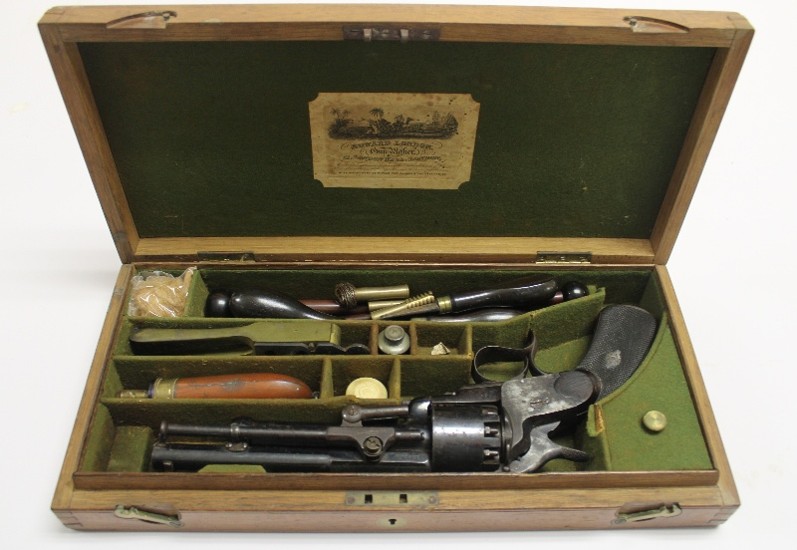
Le Mat Confederate Revolver and Repair Box, collection of the BMHS
When not working at the museum, I visited numerous sites of historical and natural beauty in Barbados. Two of the highlights were Graeme Hall Nature Sanctuary and Sam Lord’s Castle. The former is the largest remaining red and white mangrove forest in Barbados and offers an opportunity to see a huge variety of birds, animals, reptiles and marine life. Sam Lord’s Castle is located on the east coast of Barbados in the parish of St. Philip. Built in a Georgian style, it is said to be inspired by Windsor Castle and decorated with ornate painted ceilings.
Sam Lord was the son of John and Bathsheba Lord, enslavers and owners of Long Bay plantation in St. Phillip. Sam inherited all the family property and expanded it throughout the island, using money raised from causing shipwrecks. In 1820, he replaced the old plantation house he had inherited with an opulent and magnificent Regency mansion. The total cost was £20,000 to £30,000, the equivalent value to several Barbados sugar estates. Architectural features included classical mahogany columns, decorative ceilings, plaster “eyebrows” over the windows, and decorative recessed panels. Craftsmen from Europe were hired to lead much of the work, and some settled in Barbados after and worked on other grand houses throughout the island. However, it is important to note that these men would not have carried out the work exclusively and would have relied on the skilled labour of enslaved people to carry out the work.
The tale goes that he would place lanterns along the shore to trick ships into running aground on the reefs, where the ships would be looted. In 2010, a fire left only the frame of the castle standing, which is now overlooked by a hotel of the same name. The life of Sam Lord or “The Pirate Lord of Barbados” has inspired literature and songs; for instance, The Merrymen, a much-loved Bajan calypso band active from the 1960s to the 2000s, wrote ‘The Legend of Sam Lord’ (1975), with lyrics that reflect his reputation for initiating shipwrecks off the east coast of Barbados by luring ships to a dangerous reef where they would be shipwrecked and then plundered:
“He used to hang de lanterns
On de coconut trees
And lure ships upon de reef
And when de sailors thought
They’s sighted land,
Alas they ran a ground
Alas they ran aground!”
‘Legend of Sam Lord’, The Merrymen sing Beautiful Barbados, 2004 (re-release)
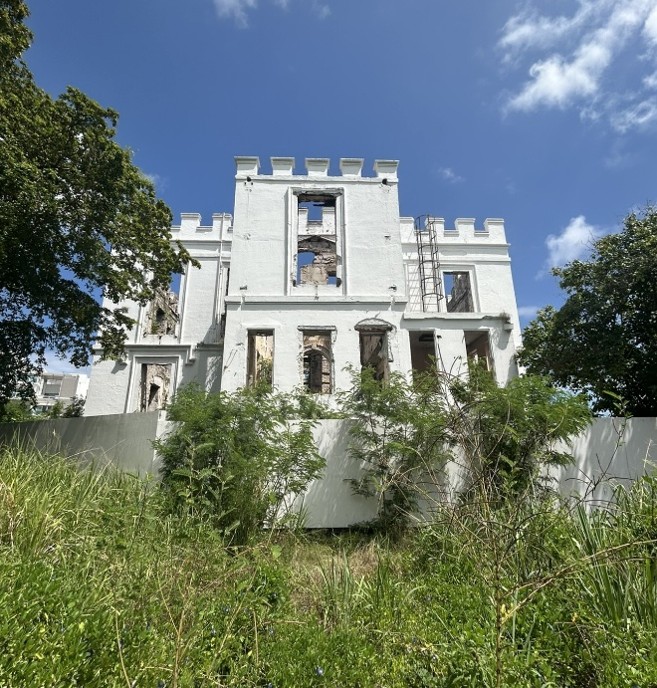
Sam Lord’s Castle, St. Phillip
Other highlights of the trip included St Nicholas Abbey, a historic plantation house; Bridgetown Market; the opening of Harriet Thomas Weekes: The Right to Opacity at The Barbados Museum & Historical Society; the Barbados Agricultural Festival; and a celebration of Afro-Ghanaian Independence. I feel extremely grateful that the Economic & Social Research Council facilitated this placement, which has contributed immensely to my professional and personal development. Finally, I would like to thank my placement supervisor, Dr. Natalie McGuire, Curator Cherrie Parris-Bourne, and Curatorial Assistant Malique Shorey for making me welcome and providing their expertise throughout the placement.
Images: From the Collection of the Barbados Museum & Historical Society

