 North West Social Science Doctoral Training Partnership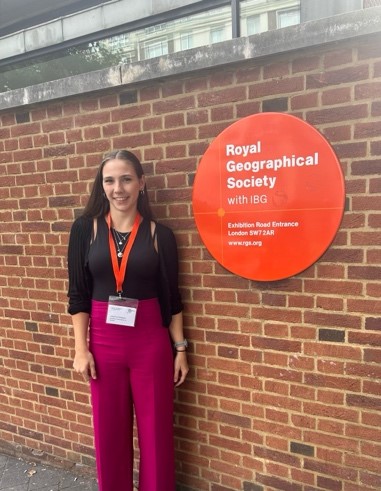
Chloe Fox-Robertson, Geography & Environment, University of Manchester (2022 Cohort)
Last week, I was fortunate to attend the RGS-IBG Annual Conference in London, supported by the NWSSDTP Research Training Support Grant. Over 2,000 geographers and others from beyond the discipline came together to share and discuss new research ideas and directions. Although united under the Chair’s theme ‘mapping’, sessions were numerous and varied, from decolonising urban futures to mapping the geographies of AI to more-than-human cartographies. Not only was this my first time attending an academic conference, but it was also my first time presenting and convening a session. During this piece, I reflect on these first-time experiences and share some advice and tips for navigating a conference.
Before attending, have a look at the conference programme. Having a plan can make the experience less overwhelming. Familiarise yourself with the structure of each day, including session timings and breaks. For each day, identify one or two sessions you are set on going to, and one or two sessions you would like to attend if you feel able. Most importantly, don’t forget to note down the time and location of any sessions you’re presenting in.
As tempting as it might be, don’t fill your entire day with sessions. One of the best pieces of advice I received was to allot time for rest. I found the conference incredibly exciting and enriching but also quite draining. At the RGS-IBG Annual Conference, the venue had a lovely outdoor area with picnic blankets and chairs, providing a perfect spot to take a break and recharge. You could also read a book, listen to music, or go for a walk – whatever works best for you. Also, make sure to stay well-hydrated and nourished. Although it might sound simple, amidst everything going on at the conference, it can be easy to forget these things.
The conference programme includes numerous sessions throughout the day with many occurring in parallel – there are probably multiple places you’ll want to be at once. To help you decide which session to attend, look at the presentation titles rather than just the session name since this will give you a clearer idea of what will be discussed. Additionally, don’t limit yourself to solely attending sessions directly relevant to your PhD. Take advantage of the opportunity to go outside of the topics in your immediate field of research and pick at least one session focused beyond your PhD that you find intriguing or exciting – it may even turn out to be relevant in an unexpected way.
Before the opening plenary session, I attended the Newcomers’ Symposium for postgraduates and first-time attendees. This welcome session included a workshop on peer review, which went through each stage in the process and provided valuable insights into how to manage difficult situations such as when reviewers disagree (hint: contact the editor). Following this was a postgraduate-led panel on making the most of the conference, where much of the advice shared here was mentioned. If you are attending a future RGS-IBG Annual Conference, I cannot recommend the Newcomers’ Symposium (or a similar event if you are at another conference) enough; it made the conference seem much more manageable because I knew more about what to expect, received advice for navigating the conference, and met several people in this smaller group that became familiar faces over the next few days.
I was also fortunate to join a tour of the conference venue on the first day, although just wandering around the location could be equally useful if no tour is available. Becoming more familiar with the venue, including learning where I was presenting and where the next day’s sessions were, helped to alleviate some anxiety I had been feeling.

During each session, participate as much or as little as you feel is necessary and comfortable. Sitting and listening is as equally valid as taking lots of notes. If you’re curious about a presenter’s research, don’t hesitate to ask a question following their presentation or, if you don’t feel comfortable asking in front of everyone, approach them after the session – most presenters tend to linger for a little bit. Furthermore, if someone’s research aligns closely with yours, consider asking them for a more in-depth conversation, which can lead to valuable advice, feedback, or even a future collaboration. Remember, most academics are happy to discuss their work and eager to engage and support others.
Research groups organised various socials during the conference. I attended two social events: the Women in Economic Geography evening social and the Gender and Feminist Geography Research Group lunch. I would encourage everyone to attend one or more of the socials; they provided a great opportunity to meet people with similar research interests, and it was nice to see the people I’d met here at other times during the conference. With that said, it’s also perfectly fine to take some time for yourself – go on a walk or enjoy some quiet time alone.
Convening a session was a first for me and it turned out to be a rewarding experience. A session convenor is responsible for proposing a session idea, reviewing submitted abstracts and managing the session, including introducing speakers and keeping time. I was invited to co-convene a session by an academic who had come across my research on gender inequalities in FinTech and thought my expertise would complement her session on the everyday geographies of gender and finance. With the presenters already selected, my role involved facilitating the Q&A. With a smaller-than-expected audience, I opted to turn the Q&A into more of an open group discussion, which worked well. This experience has boosted my confidence to submit a session or panel idea at a future conference.
I presented my research on the final morning of the conference. Particularly since it was my first time, presenting at an academic conference felt like a rather daunting prospect, however, I thoroughly enjoyed the experience. With the conference being so action-packed, you’d be hard-pressed to find time to work on your presentation while you’re there. I think the best approach is to prepare as much as possible beforehand. You’ll feel more confident if everything is ready in advance and you’ve had time to practice. It can also be useful to practice in front of a few friends to mimic what it’s like presenting to an audience and don’t forget to time yourself – make sure your presentation fits within the allotted time.

When it’s time to present, I found two tips stuck with me: first, take a deep breath before you start speaking and second, speak slower than you think is necessary – it’s easy to speed up when you’re nervous, so consciously slow down. You’ll likely be asked a few questions following the presentation but try not to overthink this. Even if you’re asked a difficult question, it’s okay to say you’re not sure and you could even invite others to share their thoughts. However, chances are you know the answer because you’ve been working on this research for months if not years. Trust in your knowledge and expertise!
Finally, don’t forget to take some time to explore the local area. Conferences are often held in interesting cities and it’s worth taking advantage of being in a new place. Even though I had visited London before, I still set aside some time to be a tourist – I took a walk in the nearby Kensington Gardens and visited the Houses of Parliament later in the week.
Attending the RGS-IBG Annual Conference left me feeling re-energised about my research and full of new ideas. I made valuable connections and received constructive feedback on my research. For geographers or those in related fields, the RGS-IBG Annual Conference is a fantastic choice for a first conference experience.
About the author: Chloe Fox-Robertson is a second-year doctoral researcher in Human Geography at The University of Manchester. Her research, funded by the NWSSDTP, focuses on the gender inequalities within FinTech (financial technology). Contact Chloe via LinkedIn, Twitter/X (@chloefoxr) or email (chloe.fox-robertson@manchester.ac.uk).
 North West Social Science Doctoral Training Partnership
wow!! 73I’ve discovered exciting connections between my research and environmental history
LikeLike
Pingback: Attending The 2025 Annual RGS-IBG International Conference (Birmingham)* | North West Social Science Doctoral Training Partnership