 North West Social Science Doctoral Training Partnership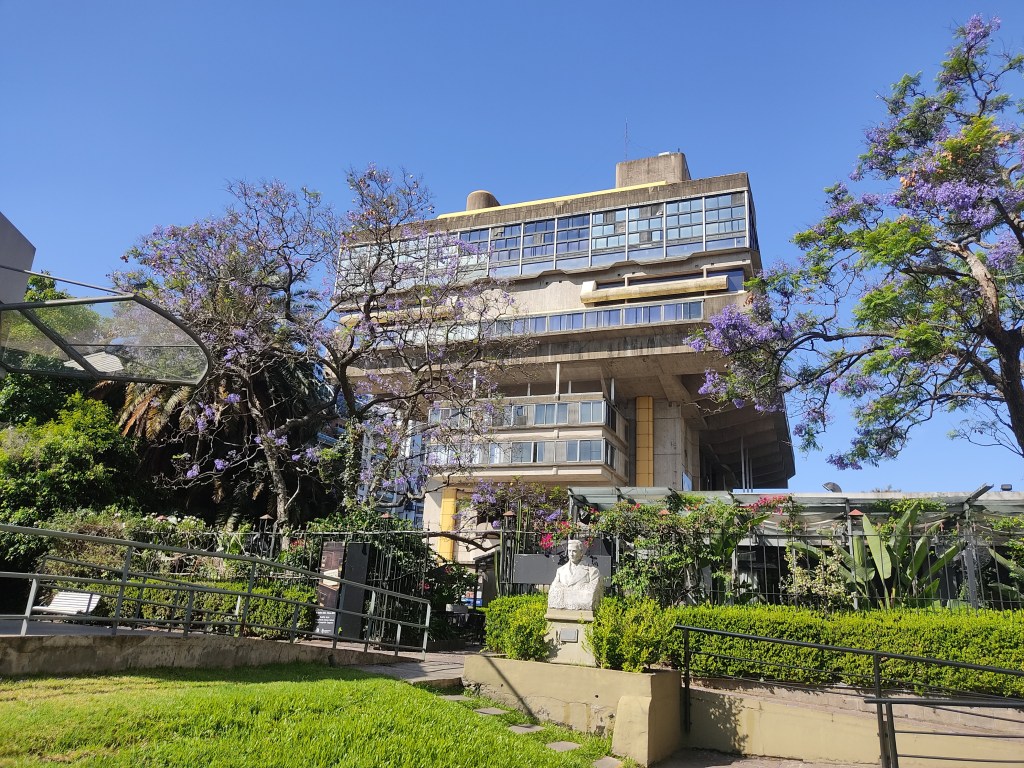
Dylan Bradbury, Language Based Area Studies, University of Manchester (2020 Cohort)
As part of fieldwork preparations in the second year of my PhD, I had the opportunity to carry out six months of Mapuzugun classes using the Difficult Language Training (DLT) funding provided by the NWSSDTP. These classes proved to have a great impact on my fieldwork, both in terms of the development of the thesis itself and in my experience researching abroad more generally.
Mapuzugun is the language of the Mapuche people, Indigenous to what are now the Northern Patagonian regions of Argentina and Chile. My PhD research explores the role of sound, listening and aural media in Indigenous Argentina. I am particularly interested in the way music, spoken language and other kinds of sonic expression have shaped Mapuche cultural politics and identity within the modern Argentine nation. Studying this topic has involved a combination of ethnographic and archival work, as well as the analysis of a wide variety of media and cultural productions.
As I put together my plans for doing the research in Argentina, it became clear it would be important to spend some time becoming familiar with Mapuzugun. This would help with the media I would be analysing, some of which is in or heavily references the Mapuche language – for example, in music lyrics and poetry. But also, as a threatened minority language, Mapuzugun revitalisation lies at the heart of the resurgence of Mapuche culture today. Involving myself in this process as a language student was a perfect way to begin exploring the links between spoken language and identity in the Mapuche context.
Beyond the benefits to my specific project, undertaking language training in preparation for any overseas research – especially if it involves ethnographic work – can be extremely useful for gaining access to organisations and communities, as well as building relationships with potential interlocutors. In a general sense, taking an extended amount of time to become familiar with a local language demonstrates a degree of dedication to the issues and contexts you are studying, and shows a genuine openness to learning which is likely to be well received.
This is especially important with research that involves – even indirectly – Indigenous, Afro-descendant or minority groups. Anyone working in these contexts should, as an ethical and political priority, consider the long and ongoing history of unequal power relations between Western academia and such communities. One major aspect of this is epistemic: the extraction of knowledge from local communities, using frameworks designed from afar, and presented in ways only relevant to the social context of the researchers. This includes the language(s) in which the research is carried out.
It’s worth mentioning that, nowadays, many members of Indigenous and Afro-descendant communities are politically conscious, highly educated, and often academics themselves. This is certainly the case amongst Mapuche circles in Argentina, and if I somehow hadn’t become familiar with these power dynamics before beginning my research design, many of my contacts wouldn’t have pulled any punches in pointing them out!
For me, this meant that it was therefore crucial not only to be aware of my own positionality as a White European researcher from a major Western university, but also to make sure that this awareness was reflected in the approach I take to the research itself. This partly entailed basing my research around a respect for the knowledge of my contacts – knowledge which is difficult to separate from the language in which it is formed. Taking all this into account, it made sense to make an effort to learn at least the basics of Mapuzugun.
This was my main rationale for taking the language classes, for which I initially took three of the six available months of DLT extension. I did this with the Laboratorio de Idiomas, an institution linked to the University of Buenos Aires. There were about ten regular students in the classes, most of which were Mapuche people themselves living in cities around Argentina. While the classes themselves were mostly online, there were often a variety of events related to Mapuzugun and other aspects of Mapuche culture happening in Buenos Aires, where I was living at the time. For example, talks and performances are often held in the auditorium of the National Library (pictured).
Having contact with Mapuzugun educational circles through the language course introduced me to a variety of Mapuche artists and activists, some of which became very useful interlocutors and interviewees for the other parts of the project, while others have become good friends. I then decided to apply for an additional three months of DLT provision, as it became clear that the classes were directly useful to my research. My teacher introduced us to various historical texts, audio recordings and studies about the language, and spending more time engaging with Mapuzugun helped me better grasp some of the sensorial dynamics.
For example, even though the task of systematically writing down Mapuzugun is a hot topic (with over twenty-five different alphabets in use) many speakers maintain it is ultimately an oral language whose significance can only really be captured out loud. As I have become more proficient in the language, I have also become much more aware of these sonorous, prosodic characteristics of spoken Mapuzugun. This has been really interesting to get my head around, and I was recently able to present some of these findings at a workshop in the UK.
Overall, I’m grateful for having had the chance to learn a language that, while perhaps not the most useful in terms of numbers of speakers around the world, has allowed me to engage with my research context much more deeply than I otherwise would have been able to. For all the reasons that I mention above, I would have tried to learn some Mapuzugun regardless of the DLT – and having now moved to the South of Argentina, I continue to do so in my spare time. Nevertheless, the extension and funding gave me time to do this with a focus that wouldn’t have been feasible during what was already a difficult year of independent research.
I’d definitely recommend to any NWSSDTP-funded PhD students planning to carry out research abroad, or even with communities at home who speak a different language, to consider applying for the DLT extension. Beyond the practical benefits for the PhD project, the personal and professional connections that can emerge as a result of engaging with language learning make it worthwhile.
 North West Social Science Doctoral Training Partnership