 North West Social Science Doctoral Training Partnership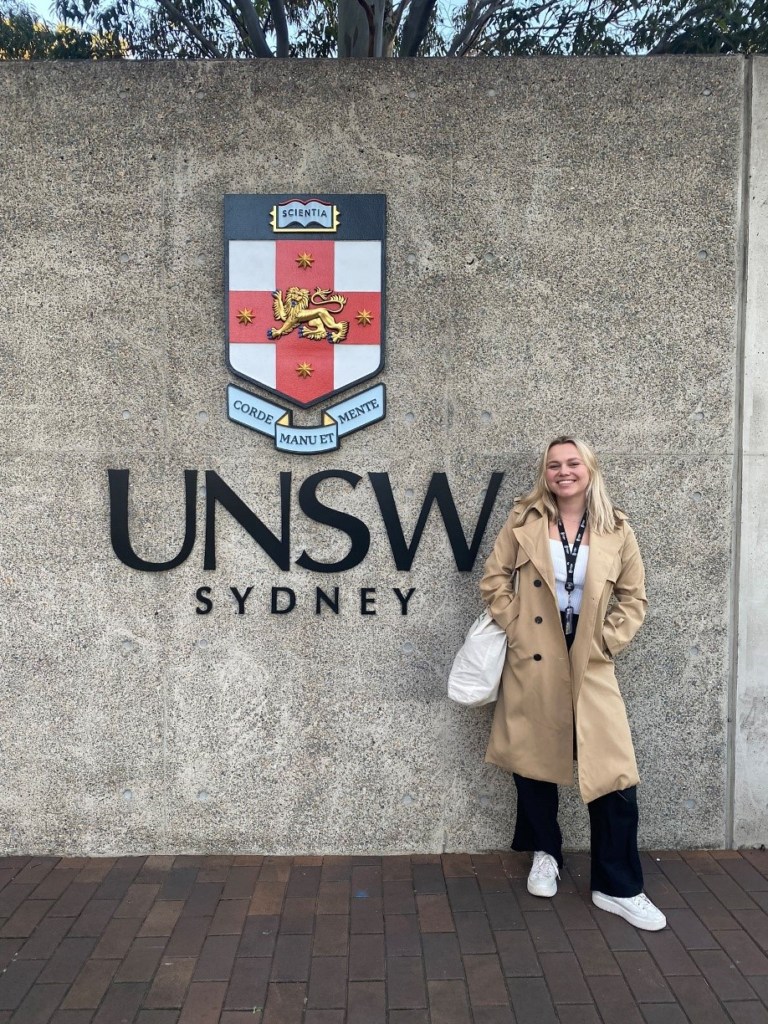
Olivia Fletcher, Geography and Environment, University of Liverpool (2020 Cohort)
Throughout my PhD, I had limited in-person networking opportunities because of the COVID-19 pandemic. When I reached the third year of my PhD I wanted to take the opportunity to visit an overseas institution. I decided to visit Professor Deborah Lupton at the Vitalities Lab, UNSW for four weeks. Deborah’s work has had a significant influence throughout my PhD, which focuses on young people’s use of health-tracking technologies. Deborah leads the Vitalities Lab, which brings together researchers working on understanding human experience in the context of the more-than-human worlds and their research includes critical digital health studies, living digital data, digital food cultures and innovative social research methods.
Whilst at UNSW, I met with Deborah to discuss my PhD. I was at the stage of my PhD where I had most of the thesis written up and I was using a theory called feminist new materialism, which Deborah has engaged with a lot in her own work. Deborah very kindly read one of my chapters and discussed my use of the theory, which helped me when editing my chapters. I was also able to meet with other members of the team, including other visiting PhD students. It was great to have more informal research conversations and one member of the lab also organised creative methodology sessions. These involved individuals testing their creative research methodologies such as, board game design and creative writing and involved some very productive and interesting conversations around data collection and analysis. These sessions inspired me to use similar methods in future research projects. I was also very lucky to start my visit at the same time as the opening of the team’s more-than-human wellbeing exhibition and I was able to learn more about how research can be shared through more arts-based and multisensory methods.
Throughout my visit, I was editing chapter drafts and it was extremely beneficial for me to do so in a new environment and surrounded by people who have similar research interests to me. This gave me new inspiration and the further motivation to complete the PhD. At the end of my visit, I had the chance to present my thesis to the group. This was extremely useful for me to be able to summarise my thesis and also led to a very useful discussion about my thesis, which gave me some insight into some of the questions that might be asked within my viva.
Whilst I was in Australia, I also made sure that I took the opportunity to explore the country. I was able to take two weeks to travel before I began my four-week visit at UNSW. This involved me travelling up the East coast of Australia from Sydney to Cairns and I was lucky enough to visit; Byron Bay, Surfer’s Paradise, Fraser Island, Whitsundays and the Great Barrier Reef. I went on multiple snorkelling trips and saw some beautiful places. I also spent the moments that I wasn’t working on my PhD to explore Sydney and the surrounding areas. This involved me spending time whale watching on the Sydney beaches, going to the Blue Mountains, exploring Jervis Bay and exploring the city itself.

The visit to UNSW was an extremely valuable part of my PhD. I was able to meet and connect with new people, experience academia outside of the UK, gain inspiration for future research and learn from experts within my field. I’m extremely grateful that I had the opportunity to travel to Australia, especially after completing much of my PhD during the COVID-19 pandemic and I would definitely recommend completing an OIV to anyone who is considering it.
 North West Social Science Doctoral Training Partnership