 North West Social Science Doctoral Training Partnership
Dipanjan Saha, Sociology, University of Liverpool (2019 Cohort)
Earlier this year, I had the incredible opportunity to visit the Special Collaborative Research Center (CRC) at the University of Siegen in Germany for three months. This research visit not only allowed me to engage with prominent researchers in my field but also provided a unique platform to bring a new dimension to my interdisciplinary research journey. In this blog post, I will share my experiences and highlight the invaluable insights gained during my Overseas Institutional Visit (OIV) to Siegen.
The University of Siegen has earned international acclaim for its exceptional research that cuts across multiple disciplines, and the CRC is one of its main interdisciplinary research centers. It brings together over 60 researchers from diverse fields such as media studies, sociology, anthropology, computer science, engineering and medicine, and Artificial Intelligence (AI) serves as the central theme connecting the work of these researchers.
In my PhD research, I study work practices in the field of AI and Machine Learning ethnomethodologically, asking how such work gets done and what is involved in doing it. To bridge the gap between computer science and the social sciences, in the first two years of my PhD, I primarily worked with and learned from data scientists in two different settings: a commercial AI company and a leading AI research laboratory. In between these fieldworks, I had a few opportunities to present my research at different academic conferences, both online and in person. While these short trips marked significant milestones in my research journey, the OIV program presented a rare opportunity to engage in a close and extended collaboration with renowned researchers in my field. Over the years, the CRC has become a major center for ethnomethodological research in Europe, particularly in science and technology studies. Given the affinities between the research conducted at the CRC and my own work, I had long desired to visit for an extensive residency, and the OIV scheme made this possible.
During my stay at Siegen, I actively participated in a series of lectures and workshops organised by the center. One of the notable events was the book launch by Orit Halpern, a Professor and Chair of Digital Cultures at Technische Universität Dresden. Halpern’s presentation on “The Smartness Mandate” traced the genealogy of artificial intelligence, finance, and ecology, illuminating how digital technologies have transformed our imagined futures. Another memorable workshop involved Thomas Scheffer, a Professor of Sociology at Goethe University Frankfurt, who demonstrated how we can extend ethnomethodology to address existential challenges such as the climate crisis. This two-day workshop delved into the practical and analytical dimensions of the climate crisis, highlighting how we as sociologists can analyse and respond to these crises in and through our different membership categories in society. These events were examples of the thought-provoking discussions and networking opportunities that enriched my research journey.
In addition to attending lectures and workshops, I actively participated in the research colloquium organised by the doctoral researchers at the CRC. This platform allowed me to gain valuable insights into related case studies and contrasting research projects undertaken by other AI researchers within the CRC. Engaging in these discussions not only expanded my understanding of AI but also ensured that my research had real-world implications within the burgeoning field of social studies of AI. Furthermore, the informal meetings with fellow researchers at the CRC provided an opportunity to share my research findings and receive valuable feedback on my ongoing work. These conversations, both within and outside my area of expertise, helped me stay updated with the cutting-edge research and innovative methodologies in my field, providing inspiration for further exploration. Inspired by these exchanges, I utilised my three-month stay to make substantial progress in my thesis and even started drafting a new research paper.
While my focus was primarily on research, my time in Siegen offered more than just academic pursuits. The experience of immersing myself in a new city, a new country, and a new research culture was truly enriching. Although I didn’t face any language barriers within the university as English was the primary mode of communication at the center, engaging in in-depth conversations with people beyond the university proved challenging due to the language barrier. Nonetheless, my time in Siegen was delightful, and I took spontaneous trips to museums and art galleries in nearby cities like Cologne and Bonn, deepening my understanding of the region’s rich culture and history.
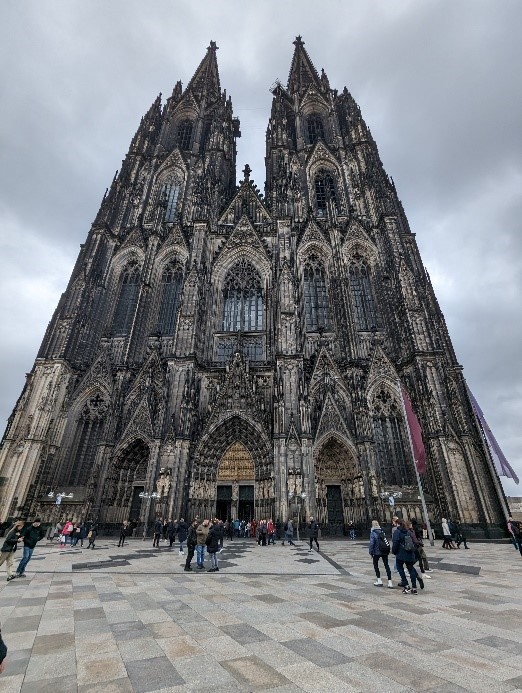
Cologne Cathedral

Schickard’s Calculator at Arithmeum, Bonn
In summary, my visit to the Special Collaborative Research Center in Siegen proved to be a transformative experience. It offered me a valuable opportunity to immerse myself in an interdisciplinary research environment which has proven itself as a renowned hub for ethnomethodological research in science and technology studies, particularly in social studies of AI. As my own fieldwork is grounded in ethnomethodology and my focus is on the methods which characterise work in AI, the experience of the visit has been incredibly worthwhile. It has provided me with momentum for my writing and the ideas that shape my work, as well as prepared me for conversations that encompass academic, industry, and societal interests in AI arising from my PhD.
I would like to express my gratitude to NWSSDTP for generously funding this research trip, enabling me to seize this invaluable opportunity. I wholeheartedly recommend my fellow researchers to utilise the OIV scheme, as it not only adds an international dimension to our research but also offers a rare chance to observe research conducted in a different country and in a different research setting. The transformative experiences, fruitful collaborations, and new perspectives gained during my visit have significantly enhanced my research productivity, and upon returning from the OIV, reignited my commitment to my PhD.
 North West Social Science Doctoral Training Partnership