 North West Social Science Doctoral Training Partnership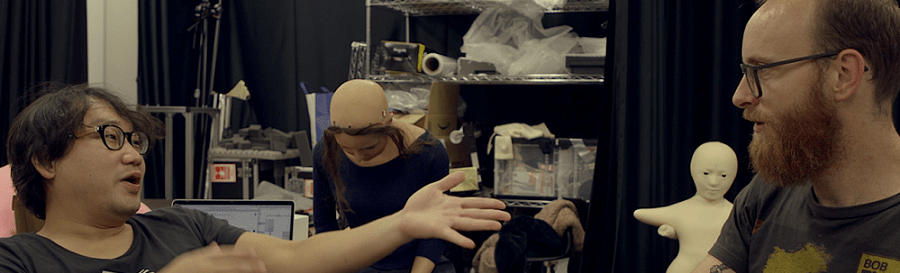
Image above: Manchester Social Anthropology doctoral student, Kristian Hoeck, engaged in conversation with informant and robotics researcher Kohei Ogawa about what makes us human. Photo taken during fieldwork at the Intelligent Robotics Laboratory in Osaka in Spring 2017, courtesy of Kristian Hoeck.
There is a large and vibrant international community of graduate students in the North West studying Social Anthropology. Prospective applicants can apply through the NWSSDTP Social Anthropology pathway to Liverpool, Lancaster and Manchester Universities. Liverpool and Lancaster have Social Anthropologists working in departments of Sociology with interests in health and medicine, STS, and Latin America. The University of Manchester has a large doctoral programme and associated ESRC-recognised MA in Anthropological Research and is home to one of the largest communities of graduate students working in Social Anthropology in the UK.
This provides numerous opportunities for cross-institutional supervision, and jointly-organised events and workshops. The Manchester department has particular expertise in political and economic anthropology; the anthropology of health and medicine; visual anthropology; the anthropology of development; the anthropology of science, technology and infrastructure; migration and displacement; questions of urban life and the built environment. Prospective applicants are encouraged to explore the respective programme and departmental web-pages and to discussed their proposed research with the prospective supervisor(s) before submitting their application.
Programmes eligible for NWSSDTP funding
The list below includes all Master’s programmes that are eligible for NWSSDTP funding and the typical PhD programmes that are supported under this pathway. Other PhD programmes within these universities may be considered – please reach out to the relevant Pathway Representative (see contact details below) or the NWSSDTP Office if the PhD programme you are interested in is not listed here. Please note that the NWSSDTP does not fund standalone Master’s programmes – these can only be funded as part of a Master’s + PhD Studentship.
Lancaster University
University of Liverpool
University of Manchester
- MA Anthropological Research
- MA Digital Media, Culture and Society
- PhD Social Anthropology
- PhD Social Anthropology with Visual Media
- PhD Anthropology, Media and Performance
- PhD Digital Humanities, Cultures and Media
- PhD Music (Musicology)
For information on how to apply for funding, please visit our How to Apply page.
Pathway Representatives
Contact details for Social Anthropology Pathway Representatives can be found here: https://nwssdtp.ac.uk/about/contact-us/pathway-leads/
Current Social Anthropology Pathway Students and Alumni

Fiona Potter (2019 Cohort)
- University of Manchester
- Weblink: https://fpott.com/
- Email: fiona.potter@postgrad.manchester.ac.uk
- MethodsX Stream: Ethnography
Songs of Horses, Songs of Home: Mongolian Kazakh Senses of Place in the Altai
This project asks how ethnic Kazakhs living in Mongolia’s westernmost province imagine and maintain senses of place, home, and belonging in an emotionally and materially turbulent context. I focus on three aspects of Mongolian Kazakh life (homeland song; semi-nomadic horse culture; and tourism in the Altai Tavn Bogd National Park) to gain deeper insights into what it means for Kazakhs to call Mongolia home.

Ciaran Cowham (2021 Cohort)
- University of Manchester
- Weblink: https://uk.linkedin.com/in/ciaran-cowham-ab364661
- Email: Ciaran.cowham@postgrad.manchester.ac.uk
Organic Values: Bureaucracy, Capitalism, and Labour in the Supply of ‘Transformative’ Edible Plants in Britain
This project ethnographically explores the intricacies of the production, distribution, and consumption of plants sold as “organic” in England. To this end, I am investigating the ways in which value is created, labour is performed, and plants are commodified by those individuals engaged in the supply chain of horticultural commodities, and whether these processes elucidate the interdependencies of bureaucracy and capitalism.

Jonathan Craig (2021 Cohort)
- University of Manchester
- Email: Jonathan.craig@postgrad.manchester.ac.uk
Hostility and Hospitality: Addressing Migrant-Reception Activity at the English Channel
My research addresses the reception of people arriving via irregular means (in small boats) on England’s south coast by anti-migrant activists and grassroots humanitarian groups in relation to broader local and national currents of hostility and hospitality. It explores competing practices of migrant reception and the concomitant relations and visions of national belonging that these practices reflect and engender.

Thomas Sullivan (2018 Cohort)
- University of Manchester
- Email: Thomas.sullivan@postgrad.manchester.ac.uk
- MethodsX Stream: Ethnography
“As Above, So Below”: Contemporary British Cosmologies of Spirituality and the New Age
Following ethnographic research in a “New Age” spiritual community in the UK, my research project explores how marginalised cosmologies and practices provide alternatives to dominant ways of conceptualising the world. Using novel anthropological approaches, my research project seeks to explore what it means to do anthropology, while also providing fresh perspectives on pressing topics such as ecology and gender.

Lydia Donohue (2022 Cohort)
- University of Manchester
- Weblink: https://www.lydiadonohue.co.uk/
- Email: Lydia.donohue@postgrad.manchester.ac.uk
The Art of the Ordinary and the Pleasure of the Necessary: quiltmaking in South Manchester
In my research, I consider how creative older-age and liveliness in later life are shaped and sustained within the craft of quiltmaking. I centre making as an active, vibrant, ongoing process that both materialises community and, through pleasurable work, contributes to joyful everyday lives. As an interdisciplinary-practitioner, I use textiles to explore the collective, the domestic, and possible futures through craft.
 North West Social Science Doctoral Training Partnership