 North West Social Science Doctoral Training Partnership
Natalie York, Development and Humanitarianism in an Unequal World, University of Manchester (2021 Cohort)
Last month, thanks to the NWSSDTP conference fund, I had the chance to attend the Wageningen Political Ecology PhD Spring School in the Netherlands. It was a 5-day intensive workshop exploring vibrant environmental conservation debates on extinction struggles, neoliberal natures, and new visions for how we can do conservation in more convivial ways. My own PhD research takes a political ecology perspective to explore how different conservation approaches protect biocultural diversity, so as soon as I read the description for this year’s Spring School, I knew I had to go. I was therefore very excited when the DTP approved my application!
While I studied an interdisciplinary MSc in Environmental Change and International Development, my undergraduate background is in physical geography, meaning reading theoretical work never formed a huge part of my studies, so I was really looking forward to a whole week dedicated to in-depth discussion of the theories underpinning the issues I work on.
The workshop was mostly classroom-based to ensure we got the opportunity to really dive into the ideas and debates, but the highlight of the course for me was our mid-week fieldtrip to Amsterdam. Although the classroom-based sessions on theory were what drew me to the workshop, it was so refreshing to get outside of the university and spend time in the city and in nature. I often feel like there is a bit of a disconnect in academia, particularly with conservation social scientists, where we spend a lot of time studying environmental issues through talking and writing without actually spending time enjoying the outdoors, and so it felt good to disrupt that in the Spring School.
Our morning involved a visit to Voedselpark Amsterdam in Amsterdam Nieuw-West, significant for being the city’s last agricultural land. Located on the Lutkemeerpolder, rich with fertile organic sea clay, the local community have a vision for Voedselpark to be one of the largest urban agricultural parks in Europe. However, a group of local activists are currently engaged in a battle with the municipality of Amsterdam to prevent the Schipol Area Development Company from building distribution centres on the land. We had the privilege of learning from the activists at Boterbloem about how they are resisting the plans, and even got to give back to the park in small way by getting involved in weeding, mowing, and cleaning out the goats!

After lunch, we took the tram across to De Hortus, the city’s botanical gardens, where we had been invited for a discussion about the gardens’ efforts to decolonise. Unsurprisingly, this led to some quite heavy discussions, but resulted in brainstorming a number of concrete ideas that the Hortus could implement moving forward. Feedback from the Hortus was very positive and it was brilliant to be part of what felt like an informal consultation, applying our classroom discussions about decolonising environmental governance to addressing a very real need for practical change.
As well as the value I took from exploring how political ecologies of conservation could apply to places like Voedselpark and De Hortus, it was also just thoroughly enjoyable to spend time in these places and immerse ourselves (mentally and physically!) in the work going on here.
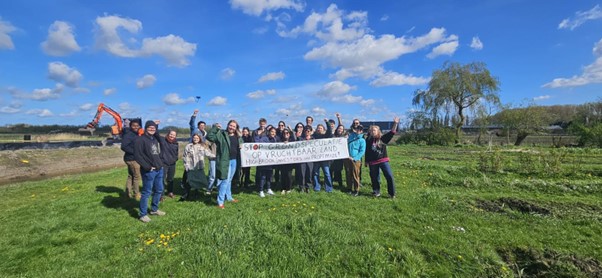
Big thanks to Professor Bram Büscher and the team at Wageningen University for organising the week and to all the lovely people I met who made the Spring School such a fun experience. If you are interested in political ecologies of conservation, this is one to keep on your radar!

 North West Social Science Doctoral Training Partnership